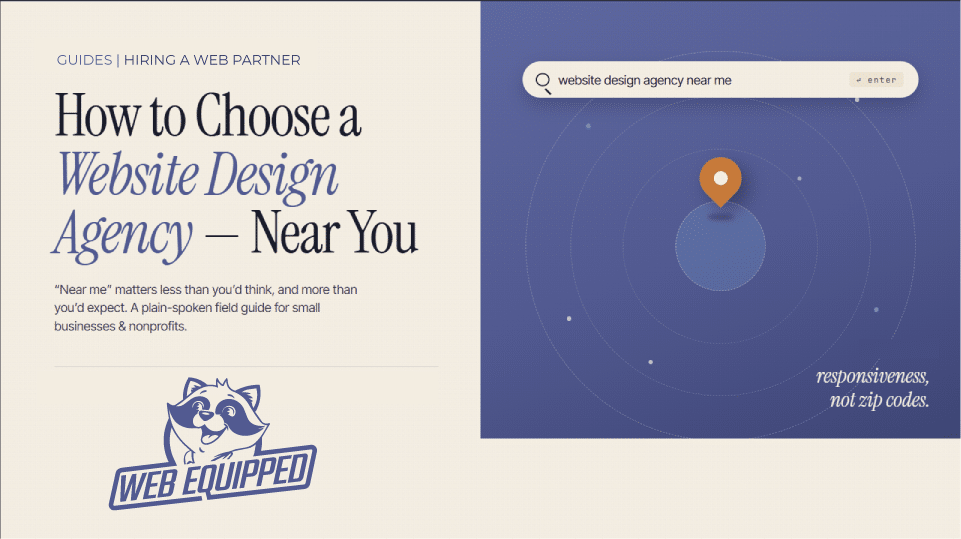
When choosing a website design agency the primary factor in your decision should not be location. More importantly its the person building your site is the same person you’re talking to, and whether the scope and price are in writing before anything starts.
That said, “near me” searches return hundreds of results that all look identical, and telling them apart is genuinely hard. Every agency claims they build beautiful websites, communicate openly, and deliver on time. Most of them are not lying exactly — they’re just not telling you the full picture. This post is the full picture: what to look for, what to ask, and what to walk away from — based on building and maintaining websites for small businesses and nonprofits across the US.
Does “near me” actually matter?
Probably less than you think — and in one specific way, more than you’d expect.
The honest answer is that geography matters very little for most web projects. Web Equipped works with clients across the United States entirely remotely. Discovery calls happen on Zoom, design approvals happen through shared links, and feedback rounds happen over email. We have never needed to be in the same room as a client to build them a great website. However, a design agency like Web Equipped has services that go beyond what’s on the web. If your project requires photography, audio, or videography, then locality becomes more important. Stock imagery vs real photos of your business / non-profit is a different conversation.
What “near me” is really asking is: can I actually reach this person when I need them? That’s a question about communication and responsiveness, not zip codes. A local agency that takes four days to reply to an email is worse than a remote agency that responds same-day.
That said, there is one scenario where geographic proximity genuinely helps. If you’re a local service business — a preschool, a law firm, a nonprofit — working with someone who understands your specific market, your local competitors, and the search behavior of people in your area has real value. Not because they need to be physically nearby, but because local market knowledge informs better decisions about SEO, content, and positioning.
So when you search “website design agency near me,” filter for responsiveness and local knowledge — not just a local address.
The questions most small business owners forget to ask
Most people ask agencies for a portfolio and a price. Both matter, but neither tells you the whole story. Here are the questions that actually separate good web partners from frustrating ones.
Who will actually be building my site?
This is the most important question on the list and the one asked least often. Many agencies — particularly mid-size and larger ones — take your project, hand it to a junior developer or offshore team, and manage the relationship while someone else does the work. There’s nothing inherently wrong with this model, but you should know it’s happening before you hire.
At Web Equipped, the owner is the project manager. Not a subcontractor, not a junior team member. You communicate directly with the person doing the work from day one through launch. If something needs to be fixed at 9pm before a deadline, you’re not waiting for a chain of command to relay the message. That said, when needed, we subcontract in a unique way that doesn’t disrupt our project or communication. Browse our portfolio to see some of our collaborations with awesome graphic designers.
What does your pricing model look like — and what triggers extra charges?
Fixed-scope pricing and hourly billing produce very different experiences. With hourly billing, every question you ask, every revision you request, and every meeting that runs long adds to your invoice. With fixed-scope pricing, you know the number before anything starts and it doesn’t change unless the scope does.
Ask specifically: what happens if I want to add a page after the project starts? What if I need more than one revision round? What if the timeline extends because my content isn’t ready? Get clear answers to these before signing anything.
What platform do you build on — and why that platform specifically?
“We build in WordPress” is not a complete answer. WordPress powers around 43% of all websites on the internet, which means it’s the right choice for many clients — but not automatically the right choice for every client. The right follow-up question is: why WordPress for my specific business?
Web Equipped builds on WordPress using the Divi framework because it gives small business clients the flexibility to manage their own content after launch without needing developer help for every small change. That’s a specific reason that connects platform choice to client benefit. Vague answers to this question — “we use WordPress because it’s powerful” — suggest the agency defaults to what they know rather than what suits you.
What happens after my site launches?
Launch day is not the end of the project — it’s the beginning of the site’s working life. WordPress core, themes, and plugins require regular updates. Security needs ongoing monitoring. Performance degrades without maintenance. Ask every agency you talk to what post-launch support looks like and what it costs.
Some agencies charge hourly for every post-launch change. Some offer retainers with monthly hours. Web Equipped offers a flat $100/month maintenance plan that covers security monitoring, daily backups, all plugin and WordPress core updates, and a bank of development time each month. No hourly billing surprises, no support tickets that sit unanswered for a week.
Can I see examples of sites you built for businesses like mine?
A portfolio full of restaurant websites tells you very little if you’re a law firm. A portfolio full of e-commerce stores tells you very little if you’re a nonprofit. Ask to see examples specifically from your industry or client type — and if they don’t have any, ask how they approach industries they haven’t worked in before.
Web Equipped has built sites for nonprofits, preschools, law firms, staffing agencies, and small service businesses. The approach differs meaningfully between each. A nonprofit needs donation infrastructure and funder credibility signals. A preschool needs enrollment pathways and program pages parents can navigate on a phone. A law firm needs attorney bios, practice area pages, and local SEO signals. We know these differences because we’ve built these sites — not because we’ve read about them.
Red flags to watch for before signing
Vague timelines with no written scope
“Usually around six to eight weeks” with no documentation of what’s included in those six to eight weeks is a warning sign. A legitimate web project starts with a written proposal that specifies: which pages are included, what functionality is covered, how many revision rounds are included, who is responsible for content, and what the launch process looks like. If a proposal doesn’t include these specifics, ask for them before signing.
No clear answer on who owns the site after completion
You should own your website. Your name should be on the domain registration. Your account should hold the hosting. Your WordPress installation should be yours to take elsewhere if you ever change vendors. Some agencies build sites in proprietary systems or retain ownership of the hosting account as a way of keeping clients locked in. Always ask directly: if I stop working with you, can I take my site with me?
At Web Equipped, you own everything. The domain, the hosting account, the WordPress installation. If you ever opt out of our monthly support plan, you leave with your complete site and all assets.
Pricing that requires a long-term contract before you’ve seen their work
Annual contracts before a single page has been built are a red flag. They suggest the agency knows retention relies on contractual obligation rather than satisfaction. Web Equipped’s Monthly Support Plan runs month to month. We earn continued business through the quality of what we deliver, not through lock-in.
A portfolio that looks great but bears no resemblance to your business
Beautiful portfolio pieces built for well-funded startups or consumer brands don’t tell you much about how an agency handles a five-page website for a local accountant. Look for portfolio work that reflects the scale, budget, and complexity level of your actual project.
Questions to ask yourself before reaching out to anyone
Before you contact a single agency, get clear on these — your answers will make every conversation more productive and filter out the agencies that aren’t a good fit early.
Do I know what pages I need? A basic small business site typically needs: homepage, about, services (one page per service or a single services overview), contact, and possibly a blog. If you’re unsure, start with that framework and let the agency help you refine it.
Do I have content ready — or will I need help writing it? The single most common reason websites launch late is content. Photos, copy, staff bios, service descriptions — these all need to exist before the final site can be built. If you don’t have them ready, build that into your timeline and budget. Web Equipped offers copywriting support as an add-on if you need help. See our copywriting services →
Quick Tip: If you decide to utilize AI tools for your website copy, ask for a list of questions to answer about your business or non profit. Share the answers, and then have it generate content for you.
What is my realistic budget? Small business WordPress websites built by a legitimate agency typically range from $2,000 to $5,000. Below that range, you’re looking at template-based work, offshore developers, or DIY builders. Above that range, you’re paying for additional scope, complexity, or agency overhead.
Do I need ongoing support after launch, or just a one-time build? If you plan to update the site yourself and handle your own maintenance, say so upfront. If you’d rather hand that off entirely, ask about monthly support options. Neither answer is wrong — but they lead to different types of agency relationships.
What the right agency actually feels like
When you find the right web agency, a few things are true simultaneously. The scope is clear before money changes hands. Communication is direct and timely — you’re not waiting days to hear back on a simple question. The proposal reflects an understanding of your specific business and goals, not a generic template with your name swapped in. And after launch, you feel like you could reach out with a question and get a real answer from a real person, not a support ticket system.
That’s what we aim to be for every client we work with. Small businesses and nonprofits that need a professional web presence without enterprise pricing, vague processes, or a developer they can never reach.
Frequently asked questions
How far does Web Equipped work with clients geographically? We work with clients across the United States. All project communication, design reviews, and approvals happen remotely via Zoom, email, and shared project tools. We have never needed to be in the same city as a client to deliver a strong result.
How long does a typical website project take? Most small business websites run 3–6 weeks from signed proposal to launch. The most common reason projects run longer is content — if photos, copy, and page content aren’t ready when development begins, the timeline extends. We communicate clearly about this at the start of every project.
What if I already have a website and just need it redesigned? Website redesigns are one of our most common project types. We rebuild your site on WordPress while preserving your existing content, URL structure, and any SEO equity the current site has built. If there are elements of your current site that are working — specific pages ranking in search, forms that convert well — we carry those forward intentionally rather than starting from scratch.
Do you work with specific industries? We work primarily with small businesses, nonprofits, and service-based organizations. Current and past clients include a glass art nonprofit, a Jewish preschool, a multi-office law firm, and a staffing agency. We also build vertical-specific pages for industries we specialize in — including nonprofits, law firms, and staffing agencies — so you can see specifically how we approach your type of organization.
What makes Web Equipped different from a larger agency? Direct access to the person building your site, fixed-scope pricing with no hourly billing surprises, no long-term contracts, and a post-launch maintenance plan that keeps your site secure and current without requiring a developer on speed dial. Larger agencies have more people, which means more layers between you and the work. We’ve found that for small business clients, fewer layers produce better results and fewer frustrations.
Is a $500 website from a freelancer on Fiverr a reasonable alternative? For some businesses at an early stage, a very basic web presence is better than nothing. But for a small business using its website as a primary marketing and credibility tool, a $500 site typically means a template with no customization, no SEO foundations, no security setup, no post-launch support, and a developer who is unavailable the moment something breaks. The gap between a $500 site and a $2,000–$3,000 site is not cosmetic — it’s structural.